
Building Sustainable Fitness Habits: Your Real Guide to Long-Term Success
Let’s be honest—you’ve probably started a fitness journey before. Maybe you crushed it for three weeks, felt amazing, and then… life happened. Work got crazy, you skipped a few workouts, and suddenly you’re back to square one wondering why it’s so hard to stick with it.
Here’s the thing: you’re not lazy or undisciplined. The problem is that most fitness advice treats habit-building like it’s some magical switch you flip. It’s not. Building sustainable fitness habits is actually a science-backed process that works with your brain, not against it, and it’s way more achievable than those Instagram fitness transformations make it seem.
In this guide, we’re breaking down exactly how to create fitness habits that actually stick—the kind that become part of who you are, not just something you “have to” do. No extreme diets, no “go hard or go home” mentality. Just real strategies that work with your life.
Why Most Fitness Habits Fail
Before we talk about what works, let’s understand why most people’s fitness habits crash and burn. According to research from the American College of Sports Medicine, about 50% of people who start a new fitness program quit within the first six months. That’s not because they’re weak-willed—it’s because they’re approaching habit formation all wrong.
The biggest mistake? Starting way too big. You get pumped up, decide you’re going to work out six days a week, overhaul your entire diet, wake up at 5 AM, and commit to becoming a completely different person overnight. Your brain recognizes this as a massive threat to your current lifestyle, and guess what? It rebels. Hard.
Another common pitfall is relying purely on motivation. Motivation is amazing when you’ve got it, but it’s unreliable. It ebbs and flows. What actually creates lasting change is building systems and habits that don’t depend on you feeling inspired at 6 AM on a Tuesday.
The third reason habits fail is lack of environmental support. You’re trying to eat healthier while your kitchen is stocked with processed snacks. You’re trying to work out while your gym bag is buried in the closet and it takes 20 minutes to find your shoes. Your environment is either working for you or against you—there’s no neutral.

Understanding the Habit Loop
Every habit follows a simple three-part loop: cue, routine, reward. Understanding this is foundational to building fitness habits that stick.
The Cue is the trigger that starts the behavior. It could be your alarm going off at 6 AM, finishing lunch, or seeing your gym bag by the door. Cues are usually tied to time, location, or emotional state.
The Routine is the behavior itself—the workout, the meal prep, the stretching session. This is what most people focus on, but it’s actually the smallest part of the equation.
The Reward is what your brain gets out of it. This doesn’t have to be food or money. It could be the endorphin rush after exercise, the satisfaction of checking something off your list, or simply the feeling of accomplishment. Your brain needs to feel rewarded, or the habit won’t stick.
Here’s why this matters: if you want to build a sustainable fitness routine, you need to work with all three parts of this loop. You can’t just white-knuckle your way through the routine and expect it to become automatic.
Start Stupidly Small
This is the single most important principle for building habits that last. And I mean actually small—smaller than you think makes sense.
Instead of “I’m going to work out five days a week,” try “I’m going to do 10 minutes on Monday, Wednesday, and Friday.” Instead of “I’m cutting out all sugar,” try “I’m swapping my afternoon soda for sparkling water three days this week.” Instead of “I’m waking up at 5 AM to exercise,” try “I’m putting my workout clothes on right after I shower.”
Why? Because small habits are easy to execute, and consistency matters way more than intensity when you’re building a foundation. When you consistently show up—even if it’s just 10 minutes—your brain starts to recognize the pattern. You’re not relying on motivation; you’re building neural pathways through repetition.
BJ Fogg, behavior scientist at Stanford, calls this approach “Tiny Habits,” and research supports it. Small, consistent actions create momentum. That momentum builds confidence. That confidence makes it easier to gradually increase intensity.
A practical example: if you’re sedentary and want to become more active, don’t jump into a HIIT program. Start with a 15-minute walk three times a week. Make it a routine. Once that’s automatic—and it will be in 2-3 weeks—you can add another day or increase duration. This approach actually works because you’re not fighting your brain’s resistance to massive change.
Design Your Environment
Your environment is doing about 80% of the work, and most people ignore it completely. If you want to build sustainable fitness habits, you need to make the desired behavior the path of least resistance.
For Workout Habits: Keep your gym bag packed and visible. Sleep in your workout clothes if you have to. Have your equipment ready the night before. Remove friction from the decision-making process—the less you have to think about it, the more likely you’ll do it.
For Nutrition Habits: Stock your fridge with foods that support your goals. Put healthy snacks at eye level and less healthy options in harder-to-reach places (yes, this actually works). Prep your meals or ingredients on Sunday so the easy choice is the healthy choice during the week.
For Recovery and Sleep: Set your bedroom temperature to 65-68°F, use blackout curtains, and keep your phone out of reach. These environmental tweaks might seem minor, but they’re the difference between sleeping seven hours and five hours, which directly impacts your fitness performance and recovery.
When you’re building strength training habits, your environment determines whether you’ll actually show up. If your home gym is in a dark basement corner behind boxes, you won’t use it. If it’s in your living room with good lighting and clear space, you will.
Track What Matters
Tracking isn’t about obsession—it’s about awareness and accountability. When you track something, you’re essentially creating a visual representation of your consistency, and that’s incredibly motivating.
But here’s the key: don’t track everything. Track the behavior, not just the outcome. This is crucial.
For example, instead of tracking “weight loss,” track “workouts completed.” Instead of tracking “calories,” track “meals prepped.” Why? Because you control the behavior; you don’t always control the outcome (genetics, hormones, sleep, stress all play roles). When you track behaviors and see yourself being consistent, that’s the reward your brain needs to reinforce the habit.
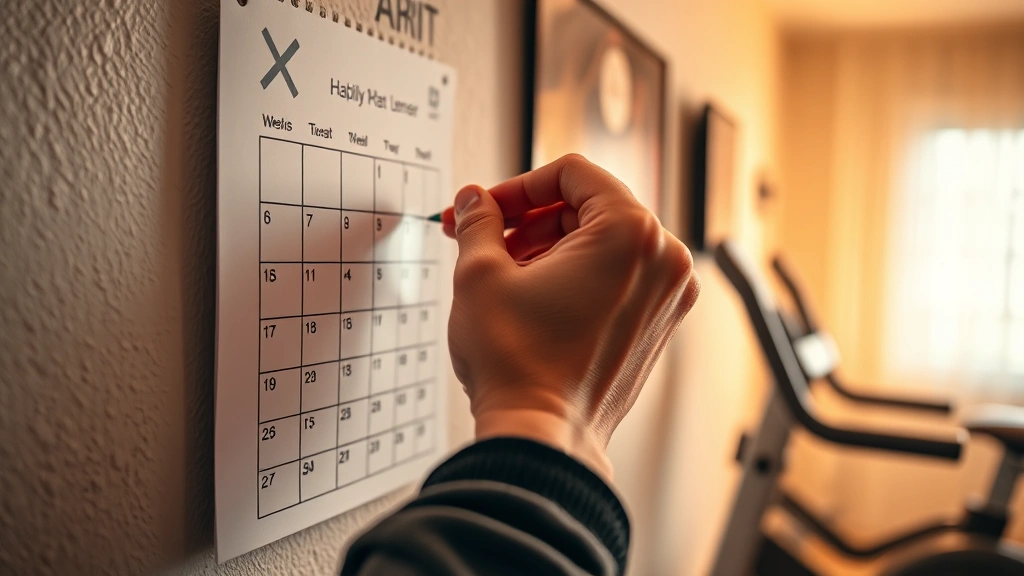
Use whatever system works for you: a calendar on your wall where you cross off each day, a spreadsheet, a habit-tracking app, or even a notebook. The medium doesn’t matter. The consistency does.
Research from NASM shows that people who track their progress are significantly more likely to maintain habits long-term. It creates accountability without judgment—you’re just observing your own behavior.
Overcome Common Obstacles
Building sustainable fitness habits means anticipating where you’ll struggle and having a plan.
Obstacle: “I’m too busy.” Solution: Start smaller. Fifteen minutes is better than zero. It’s not about finding time; it’s about making it a priority. When you build the habit first with small commitments, it becomes easier to expand later.
Obstacle: “I get bored with the same workout.” Solution: Varying your workouts is actually healthy, but don’t use boredom as an excuse to quit. Find 3-4 workouts you actually enjoy and rotate them. Consistency matters more than novelty.
Obstacle: “I had a bad week and fell off.” Solution: This is normal. Everyone misses workouts. The difference between people who build lasting habits and people who don’t is how they respond to a lapse. If you miss one workout, it’s a lapse. If you miss a week, it’s the start of a relapse. Get back on track the next scheduled day—no guilt, no drama, no “well, I blew it anyway, might as well eat pizza all week.”
Obstacle: “I don’t see results fast enough.” Solution: Results take time, and they’re not always visible on the scale or in the mirror. Track non-scale victories: better sleep, more energy, improved mood, clothes fitting differently, being able to do more reps. These happen way faster than dramatic physical changes.
Building Nutrition Habits Alongside Fitness
You can’t out-train a bad diet, and building sustainable fitness habits means addressing nutrition too. The good news? The same principles apply.
Start small with nutrition just like you do with fitness. Don’t overhaul everything at once. Pick one habit: maybe it’s drinking more water, or eating a vegetable with every meal, or having a protein source at breakfast. Get that consistent for a few weeks, then add another habit.
When you’re looking to fuel your fitness properly, focus on building habits around whole foods rather than restricting specific foods. Instead of “I can’t eat carbs,” try “I’m going to have oats or rice with my meals.” Instead of “no sugar,” try “I’m drinking water instead of soda.” Approach it as addition, not subtraction.
Your nutrition habits need to be sustainable for life. That means they have to fit your actual lifestyle, not some idealized version of yourself. If you hate meal prepping, don’t build a habit around it. Find another way to make healthy eating convenient for you.
According to peer-reviewed research on habit formation, it typically takes 66 days for a behavior to become automatic. Some habits take longer, some shorter, depending on complexity. Nutrition habits are usually on the longer end because they involve multiple decisions daily.
FAQ
How long does it take to build a fitness habit?
Research suggests 66 days on average, but it depends on the complexity of the habit and your consistency. Simple habits like a 15-minute walk might take 3-4 weeks. More complex habits like a full workout routine might take 8-12 weeks. The key is consistency—showing up regularly matters way more than the timeline.
What if I miss a day?
Miss one day, and it’s a lapse. Miss a week, and you’re slipping. Get back on track immediately at your next scheduled time. Don’t use one missed day as an excuse to derail the entire week. Everyone misses sometimes; what matters is the overall pattern.
Should I work with a trainer to build fitness habits?
A good trainer can absolutely help—they provide accountability, proper form, and personalized programming. But you don’t need a trainer to build habits. Many people successfully build them on their own with solid information and environmental design. Do what works for your budget and preferences.
How do I stay motivated?
Don’t rely on motivation. Build systems instead. Motivation is a bonus, not a requirement. When your environment supports the habit, you’ve tracked your consistency, and the behavior is small enough to execute, you don’t need motivation—you just need to show up.
Can I build multiple fitness habits at once?
Theoretically yes, but practically, it’s harder. If you’re new to habit-building, pick one or two to start. Once those are solid, add another. Your brain has limited willpower, and spreading it too thin usually means nothing sticks. Build a foundation first.
What’s the difference between a habit and a routine?
A routine is something you do intentionally and consciously. A habit is something that becomes automatic—you do it without thinking. The goal is turning your fitness routine into a habit, which is why starting small and being consistent matters so much.


