
How to Build Muscle Without a Gym: The Complete Home Training Guide
Look, I get it. Not everyone has access to a fancy gym, unlimited time to commute, or the budget for a membership. But here’s the truth that’ll actually change your life: you can build serious muscle right from your home. No excuses needed—just smart training, consistency, and a willingness to work with what you’ve got.
I’ve seen people transform their physiques in tiny apartments with nothing but bodyweight and creativity. The difference between them and those who fail? They understand that building muscle is about progressive overload, proper nutrition, and showing up day after day. Your location doesn’t matter nearly as much as your commitment.
The Science of Building Muscle at Home
Before we talk about what to do, let’s understand why it works. Muscle growth—hypertrophy—happens when you create mechanical tension on muscle fibers, causing microscopic damage that your body repairs stronger. According to the American College of Sports Medicine, this process doesn’t care if you’re lifting a barbell or fighting gravity with your own bodyweight.
Your muscles respond to three primary stimuli: mechanical tension, muscle damage, and metabolic stress. You can create all three at home. When you’re doing push-ups with your feet elevated, or holding a plank until your core’s screaming, you’re creating the same physiological response as someone benching 225 pounds. The weight is different, but the stimulus is real.
The key insight? Your muscles don’t know what they’re lifting. They only know they’re working hard against resistance. That resistance can come from dumbbells, resistance bands, your bodyweight, water jugs, or literally anything that challenges your muscles to contract against force.
Research from PubMed studies on resistance training shows that bodyweight training produces similar strength and hypertrophy gains as traditional weight training when volume and intensity are matched. Translation: you’re not leaving gains on the table by training at home.
Essential Home Equipment (Or How to Skip It)
Here’s where I’m going to be real with you: you don’t need much. But having a few strategic pieces makes everything easier and more effective.
The Honest Tier List:
- Truly Essential: Literally nothing. Your bodyweight works.
- Highly Recommended: Resistance bands (adjustable, affordable, space-saving) and a pull-up bar (even a doorway one costs $20)
- Nice to Have: Adjustable dumbbells or a kettlebell, a bench or sturdy chair, a mat for floor work
- Luxury: Barbells, squat rack, cable machine
If you’re starting from zero, grab a set of adjustable dumbbells and resistance bands. Total investment: under $100. That’s your foundation for building muscle. If budget’s tight, hit the thrift stores—old dumbbells are everywhere, and they work just as well as new ones.
The beauty of training at home is you don’t need to replicate a commercial gym. You need to understand how to progressively overload with whatever you have available.
Structuring Your Home Workouts
Random exercises won’t cut it. Your body adapts to stress, so you need a structured plan that systematically challenges your muscles while allowing recovery.
The Upper/Lower Split (4 days/week)
This is my go-to recommendation for home training because it balances frequency with recovery:
- Upper Power Day: Focus on pressing and pulling movements with heavier resistance
- Lower Strength Day: Squats, lunges, deadlift variations with challenging resistance
- Upper Hypertrophy Day: More volume, lighter weight, 8-12 rep range
- Lower Hypertrophy Day: Higher reps, metabolic stress, controlled tempo
This structure hits muscle groups twice weekly—the sweet spot for growth—while letting you vary stimulus and prevent adaptation plateaus.
The Push/Pull/Legs Split (3-6 days/week)
If you prefer more frequency or have limited time, this works great too:
- Push: Chest, shoulders, triceps (all pressing patterns)
- Pull: Back, biceps (all pulling patterns)
- Legs: Quads, hamstrings, glutes, calves
You can repeat this cycle twice weekly for more volume, or once weekly if you’re busy. The flexibility is one of home training’s best advantages.
When you’re structuring your sessions, think about recovery capacity. Hard workouts require sleep, nutrition, and stress management. Don’t just hammer away—build strategically.
Nutrition and Recovery Matter More Than Location
Here’s where most people lose the plot: they’ll do perfect workouts but eat like it doesn’t matter. Your muscles don’t grow in the gym—they grow when you’re resting and eating well.
Protein is Non-Negotiable
To build muscle, you need amino acids. According to the National Academy of Sports Medicine, aim for 0.7-1 gram of protein per pound of bodyweight daily. That’s not extreme—it’s just consistent. A 180-pound person needs about 130-180g daily. That’s achievable through chicken, eggs, Greek yogurt, beans, or protein powder.
The timing matters less than total daily intake, so stop stressing about the “anabolic window.” Just eat enough protein throughout the day.
Calories Support Growth
You can’t build muscle in a caloric deficit (well, beginners might see some recomposition, but it’s slow). You need to eat enough to support recovery and growth. That doesn’t mean going crazy—just eat with intention. Track for a week to understand your baseline, then eat slightly above maintenance.
Sleep is Where Growth Happens
Seven to nine hours nightly isn’t optional—it’s where your body repairs muscle damage and releases growth hormone. Training at home gives you flexibility to prioritize sleep. Use it.
Manage Stress
Cortisol (stress hormone) suppresses muscle growth. Training at home means you control your environment. Use that advantage. Create a space that feels good, minimize distractions, and don’t let work stress overflow into your training time.
Progressive Overload Without a Barbell
This is the secret sauce. Progressive overload—gradually increasing challenge over time—is what separates people who transform their physiques from those who stay stuck.
Methods for Home Training:
- Add Reps: If you did 12 push-ups last week, do 13 this week. Simple, effective.
- Increase Range of Motion: Do push-ups with feet elevated, or deeper squats. More distance = more work.
- Reduce Rest Time: Same exercises, same reps, less recovery between sets. Creates metabolic stress.
- Add Resistance: Use heavier dumbbells, thicker resistance bands, or add weight to your bodyweight (backpack with books, vest).
- Improve Tempo: Slower eccentrics (lowering phase) create more time under tension. Control the weight for 3 seconds down, 1 second up.
- Increase Volume: More sets and reps. If you did 3×10, do 4×10 next week.
- Change Exercise Variation: Regular push-ups → diamond push-ups → archer push-ups. Progression hidden in variation.
Track your workouts. Write down exercises, reps, sets, and rest time. Review weekly. That data tells you if you’re progressing. If the numbers aren’t going up, you’re not building muscle.
This is where a simple notebook or phone notes app becomes your most valuable training tool. Sounds unsexy, but consistency beats fancy.
Sample Programs That Actually Work
4-Week Beginner Home Program (3 days/week)
Perfect if you’re starting from zero or returning to training:
Day 1 (Upper):
- Push-ups: 3×8-12
- Inverted rows (under table): 3×8-12
- Pike push-ups: 3×6-10
- Resistance band curls: 3×10-15
Day 2 (Lower):
- Bodyweight squats: 3×12-15
- Bulgarian split squats: 3×10 each leg
- Glute bridges: 3×12-15
- Single-leg calf raises: 3×10 each leg
Day 3 (Full Body Conditioning):
- Jump squats: 3×10
- Push-up to T-rotation: 3×8 each side
- Reverse lunges: 3×10 each leg
- Plank: 3×30-45 seconds
Rest 60-90 seconds between sets. Focus on form over speed. Increase reps or decrease rest time weekly.
Intermediate 4-Day Upper/Lower Split
Upper Power (Heavy, Low Reps):
- Archer push-ups: 4×5-6 each side
- Resistance band pull-aparts: 4×8-10
- Dumbbell rows: 4×6-8
- Dips (chair): 3×8-10
Lower Strength:
- Pistol squat progression: 4×5-8 each leg
- Single-leg deadlifts: 4×8 each leg
- Bulgarian split squats: 3×8-10 each leg
- Weighted glute bridges: 3×10-12
Upper Hypertrophy (Moderate Weight, Higher Reps):
- Push-ups: 4×12-15
- Inverted rows: 4×12-15
- Pike push-ups: 3×10-12
- Resistance band face pulls: 3×15-20
- Dumbbell curls: 3×12-15
Lower Hypertrophy:
- Goblet squats: 4×12-15
- Walking lunges: 3×12 each leg
- Glute bridges: 3×15-20
- Step-ups: 3×12 each leg
- Calf raises: 3×20-25
Rest 60-90 seconds on strength days, 45-60 on hypertrophy days. This structure gives you the frequency and volume needed to build serious muscle at home.
The key to any program? Consistency beats perfection. A mediocre plan executed perfectly beats a perfect plan executed inconsistently. Pick something, commit for 8-12 weeks, and follow the progression guidelines.
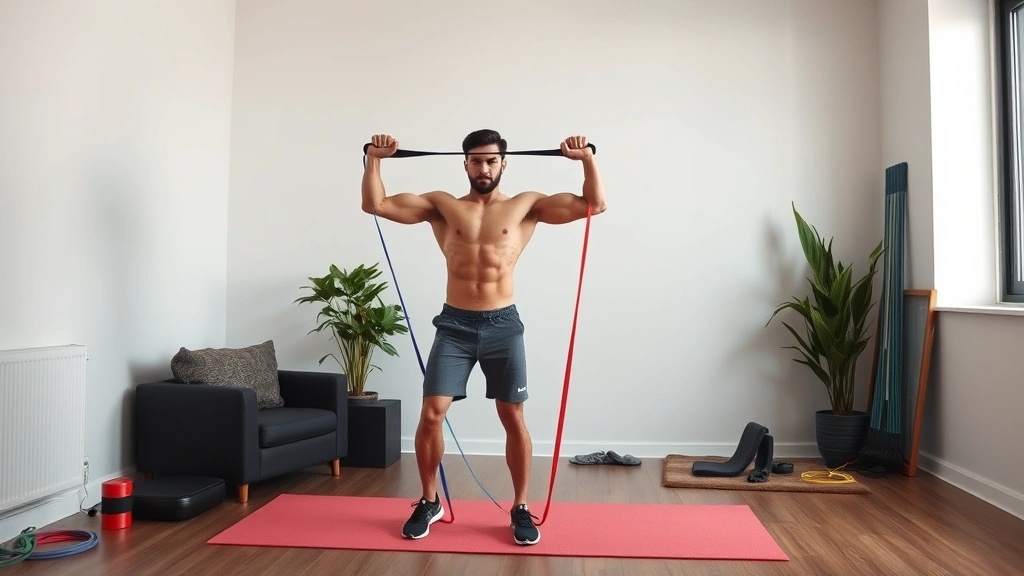
Remember that building muscle at home requires the same fundamentals as training anywhere else: resistance, progressive overload, adequate nutrition, and recovery. Your environment changes, but the biology doesn’t.
Common Mistakes to Avoid:
- Not tracking progress: You can’t improve what you don’t measure.
- Skipping leg day: Home training makes this easy to do. Don’t. Legs are half your body.
- Ignoring nutrition: You can out-train a bad diet? No. You can’t. Nutrition is foundational.
- Doing random exercises: Structure beats randomness every single time.
- Expecting overnight results: Muscle takes 8-12 weeks minimum to see noticeable changes. Stay patient.
The home training advantage isn’t that it’s easier—it’s that it’s accessible. You control your schedule, your environment, your progression. That’s powerful if you use it right.

FAQ
Can you build muscle with just bodyweight?
Absolutely. Bodyweight training creates mechanical tension and muscle damage just like weights do. The challenge is progressive overload—you need to make movements harder over time. That’s why progression variations (easier to harder) matter so much.
How long before I see muscle growth?
Strength gains appear within 2-3 weeks. Visible muscle growth typically shows after 8-12 weeks of consistent training, proper nutrition, and sleep. Some people see it faster; some slower. Genetics, age, training history, and nutrition all factor in.
Do I need dumbbells or can I train with just bodyweight?
You can build muscle with just bodyweight, but dumbbells or resistance bands accelerate progress significantly. They make progressive overload easier. If budget allows, invest in adjustable dumbbells first—they’re versatile and space-efficient.
How often should I train at home?
3-6 days per week works depending on your split and recovery capacity. More frequency (5-6 days) with a PPL split works well. Lower frequency (3-4 days) with upper/lower works great too. Choose based on your schedule and recovery ability. Quality beats quantity.
Will I get bulky training at home?
No. You get bulky from excessive calories and volume over months. Home training won’t magically make you huge—it’ll build lean muscle if you eat right and train smart. You control your aesthetics through nutrition and exercise selection.
How do I stay motivated training alone at home?
Track progress obsessively. Seeing those numbers improve is incredibly motivating. Find a training buddy (even virtually) to share progress. Take progress photos monthly. Set specific goals beyond “get bigger.” The data and visual progress keep you going when motivation dips.
Can I build muscle in a small space?
Yes. Most home workouts need just 6×6 feet. Bodyweight, dumbbells, and resistance bands take minimal space. Vertical space (for pull-ups) is nice but not essential. Small space isn’t an excuse—it’s a constraint that forces creativity.
Should I follow a specific diet for home training?
The principles are the same: adequate protein, moderate caloric surplus, whole foods, consistency. Home training doesn’t require a special diet. What matters is hitting your macro targets and eating foods that make you feel good. Mayo Clinic’s nutrition guidance emphasizes whole foods, balanced macros, and consistency—exactly what home trainers need.
How do I know if I’m progressing?
Track your workouts. If you’re hitting more reps, lifting heavier, reducing rest time, or improving form each week, you’re progressing. If those numbers haven’t changed in 2-3 weeks, adjust your approach. Progressive overload is measurable.


